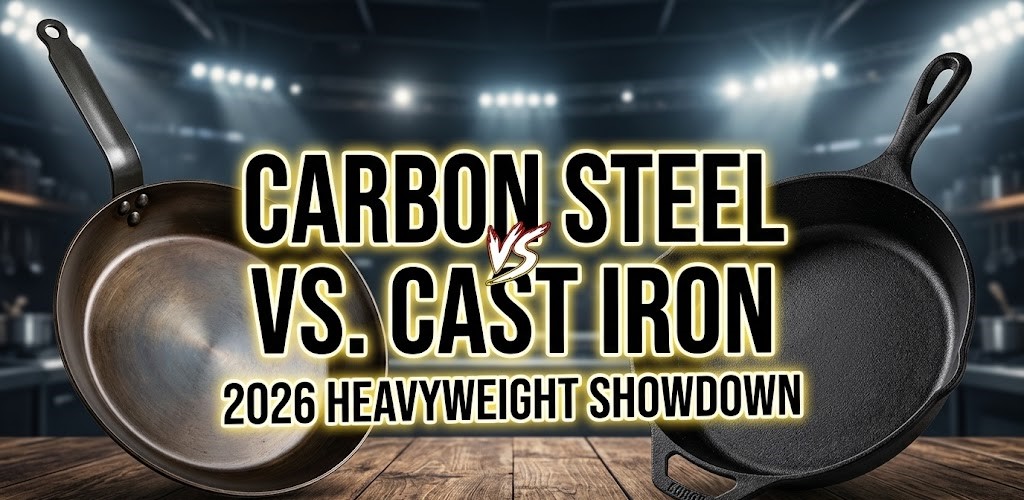
As far as kitchen investments go, we are officially in the era of “buy it for life.” In March 2026, as we pivot away from disposable non-stick coatings and back toward heirloom hardware, the debate always circles back to two titans: Carbon Steel and Cast Iron.
Both pans are essentially indestructible, can handle “rip-roaring” heat, and improve with age. But while they share a similar DNA of iron and carbon, their personalities in the kitchen are wildly different. One is a sturdy, reliable anvil; the other is a nimble, responsive blade. Choosing between them isn’t about which is “better,” but rather which one matches your cooking tempo.
Molecular Makeup: Stamped vs. Molded
The fundamental difference starts at the factory.
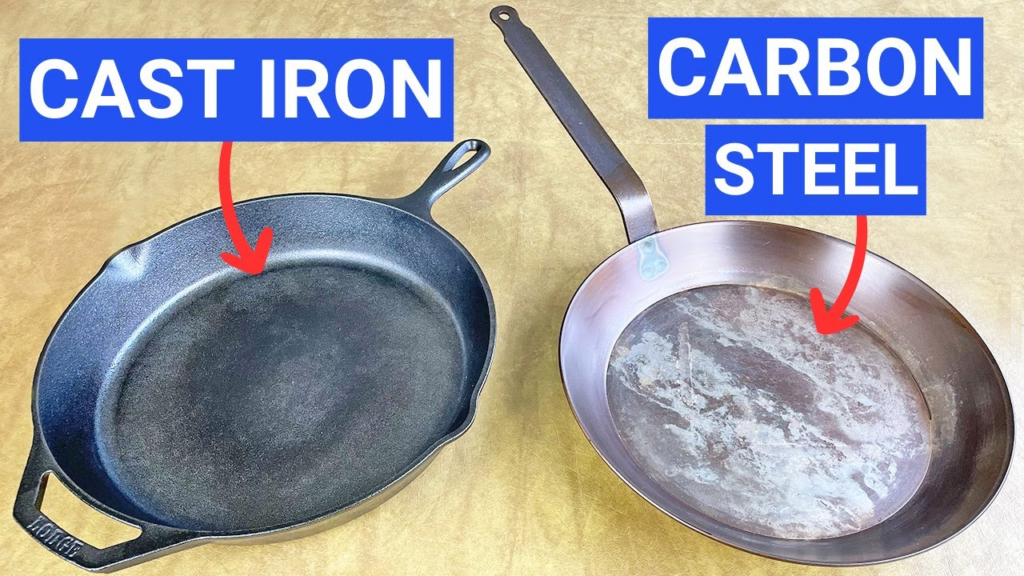
- Cast Iron: These are poured into sand molds as a single piece of molten metal. This process creates a thicker, more porous surface. According to the Lodge Cast Iron manufacturing process, this results in a pan with significant “thermal mass.”
- Carbon Steel: These are stamped from sheets of metal, then the handles are riveted or welded on. They contain roughly 99% iron and 1% carbon. Because they are pressed rather than molded, they are smoother and thinner. Insights from Misen’s Guide to Carbon Steel highlight that this makes them much more responsive to temperature changes.
02. The Physics of the Sear: Thermal Retention
Why does a steak crust better on cast iron? It comes down to the physics of heat capacity. The amount of heat energy ($Q$) a pan can hold is determined by its mass ($m$), the specific heat capacity of the material ($c$), and the change in temperature ($\Delta T$):
$$Q = m c \Delta T$$
Because a Lodge 10.25-inch skillet weighs nearly twice as much as a carbon steel equivalent, its $m$ value is much higher. This means when you drop a cold steak into the pan, the temperature doesn’t plummet. Conversely, a carbon steel pan is the “sports car” of the kitchen; it heats up faster and cools down the moment you turn the dial, giving you more control over delicate sears.
03. Maintenance and the “Polymerization” Myth
Both pans require “seasoning,” which is the process of fat polymerization. When oil is heated to its smoke point in the presence of iron, it undergoes a chemical reaction, transforming from a liquid into a hard, plastic-like solid that bonds to the metal.
- Cast Iron: Usually comes pre-seasoned. The textured surface helps the seasoning “grip” better.
- Carbon Steel: Often arrives with a protective beeswax coating that must be stripped before you start your own seasoning layers.
- The Soap Debate: In 2026, we’ve finally killed the myth that soap ruins these pans. As long as you aren’t using lye-based 19th-century soap, a little Dawn is perfectly fine for a well-seasoned pan. The Science of Cooking on Cast Iron confirms that once the oil has polymerized, it is no longer “oil”—it is a distinct chemical layer.
04. Comparison Matrix: At a Glance
| Feature | Cast Iron Skillet | Carbon Steel Pan |
| Weight | Heavy (~5–8 lbs) | Light (~2–4 lbs) |
| Heat Retention | Exceptional | Moderate |
| Responsiveness | Slow to change | Very Fast |
| Shape | High, straight sides | Flared, sloping sides |
| Best For | Baking, deep-frying, thick steaks | Sautéing, omelets, fish, stir-fry |
| Initial Cost | Very Affordable (~$20+) | Moderate (~$70–$100) |
Conclusion
If your kitchen only has room for one “forever pan,” start with a classic Serious Eats-recommended Lodge Cast Iron. Its versatility for baking cornbread and searing heavy proteins is unmatched for the price. However, if you find the weight of cast iron cumbersome or you love the “flip” of a sauté, carbon steel is your best friend. In the high-stakes world of 2026 home cooking, having both in your arsenal is the ultimate power move. They don’t just cook food; they curate it, getting better with every meal you make.
Also Read : Stainless Steel vs. Cast Iron: Architecture for the 2026 Resilient Kitchen